
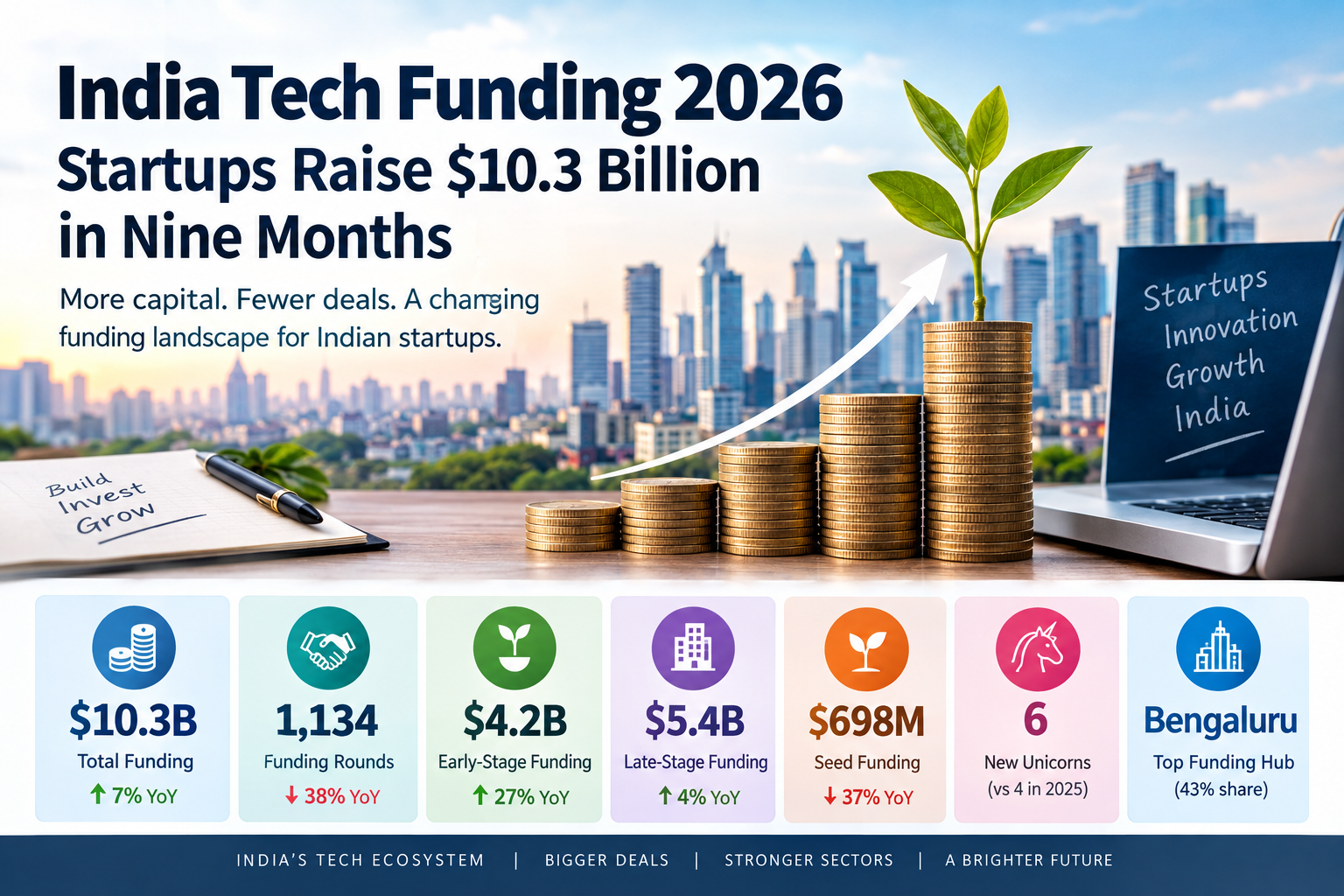
India's technology startup ecosystem raised $10.3 billion in funding during the first nine months of 2026, according to data from Tracxn. The figure represents a 7% increase from the $9.7 billion raised during the same period in 2025.
However, the headline funding increase came alongside a significant decline in the number of funding rounds. Indian technology companies recorded 1,134 funding rounds through September 21, down 38% from 1,838 rounds during the comparable period last year.
The latest numbers suggest that startup funding in India is becoming more concentrated, with larger amounts of capital going into fewer companies.
India Tech Funding 2026: Key Numbers
| Metric | 9M 2026 | Change |
|---|---|---|
| Total funding | $10.3 billion | Up 7% |
| Funding rounds | 1,134 | Down 38% |
| Early-stage funding | $4.2 billion | Up 27% |
| Late-stage funding | $5.4 billion | Up 4% |
| Seed funding | $698 million | Down 37% |
| New unicorns | 6 | Up from 4 |
| Funding rounds above $100 million | 18 | Major large deals |
The figures are based on the India Tech 9M 2026 Report from Tracxn, which tracks equity funding, exits and unicorn activity in India's technology ecosystem.
Why Did Funding Rise While Deals Fell?
The most notable feature of India's startup funding market in 2026 is the difference between total capital and the number of deals.
Total funding increased by 7%, but the number of funding rounds declined by 38%.
This means a larger share of available capital went into fewer transactions.
The trend was partly driven by several large funding rounds, including transactions worth hundreds of millions of dollars.
According to reported Tracxn data, India recorded 18 funding rounds worth $100 million or more during the first nine months of 2026.
Major Startup Funding Deals in 2026
Several large transactions contributed significantly to India's total technology funding during the period.
Nxtra: $1 Billion Funding Round
Nxtra raised approximately $1 billion in a private-equity transaction for its data-centre expansion.
The deal was the largest funding transaction recorded in the period covered by the Tracxn report.
Neysa: $600 Million
AI infrastructure company Neysa raised $600 million through Series B and C funding rounds.
The transaction highlights the growing interest in infrastructure supporting artificial intelligence and cloud computing.
CRED: $540 Million
Fintech company CRED raised approximately $540 million in its Series H funding round.
The deal was another major contributor to India's overall technology funding total.
Early-Stage Funding Increased
Not every segment of the startup market experienced the same trend.
Early-stage funding increased 27% to $4.2 billion during the first nine months of 2026, compared with $3.3 billion during the same period in 2025.
This indicates that investors continued to provide substantial capital to companies that had moved beyond the earliest stage of development.
Seed Funding Declined
Seed-stage funding showed a different pattern.
Seed funding declined 37% to $698 million, compared with approximately $1.1 billion during the same period in 2025.
The number of first-time funded companies also fell by 30% to 338 companies.
This means startups at the earliest stage faced a more difficult funding environment than companies that had already demonstrated traction.
Late-Stage Funding Remained Strong
Late-stage funding remained comparatively stable and increased by about 4% to $5.4 billion.
The difference between seed-stage and late-stage funding shows that investors were still committing significant amounts to more established technology companies.
Which Technology Sectors Attracted the Most Funding?
Several areas of India's technology ecosystem attracted substantial investment during the first nine months of 2026.
Enterprise Applications
Enterprise applications were among the largest sectors by funding value, reaching approximately $3.5 billion, an increase of 49% compared with the same period in 2025.
The sector includes software and technology products designed to help businesses manage operations, customers, employees and other business processes.
Fintech
Fintech companies also continued to attract significant investment.
The sector received approximately $2.2 billion, representing a 13% increase from the comparable period in 2025.
Financial technology remains an important part of India's startup ecosystem because of the country's large digital payments, banking and financial-services market.
Enterprise Infrastructure
Enterprise infrastructure recorded one of the strongest increases.
Funding in this segment rose to approximately $1.6 billion, compared with $292 million during the same period in 2025.
That represents an increase of nearly five times and reflects growing investment in the infrastructure required by modern businesses and digital services.
AI Infrastructure
Artificial intelligence infrastructure was also a significant funding category.
AI infrastructure attracted approximately $1.2 billion during the first nine months of 2026.
The investment includes infrastructure and technology required to build, operate and scale AI applications.
India Added Six New Unicorns
India's technology ecosystem added six new unicorns during the first nine months of 2026.
A unicorn is a privately held startup valued at $1 billion or more.
The number increased from four new unicorns during the comparable period in 2025.
According to reported Tracxn data, the six new unicorns had raised an average of approximately $101 million before reaching their unicorn funding round.
Startup Funding Is Becoming More Concentrated
The 2026 funding data points to a more concentrated investment environment.
While total capital increased, fewer companies received funding.
First-time funded companies declined by 30%, while the overall number of funding rounds dropped 38%.
At the same time, large transactions became increasingly important to the total funding figure.
For startups, this means access to capital can vary considerably depending on their stage, business model, growth and ability to attract larger investors.
Bengaluru Remains India's Major Startup Funding Hub
Bengaluru continued to lead India's technology funding landscape during the period.
The city accounted for approximately 43% of total technology funding, or $4.4 billion.
Mumbai followed with approximately $1.8 billion, while Gurugram recorded approximately $1.6 billion.
| City | Funding | Share / Position |
|---|---|---|
| Bengaluru | $4.4 billion | 43% |
| Mumbai | $1.8 billion | 18% |
| Gurugram | $1.6 billion | 16% |
| Noida | $660 million | Major funding hub |
| Delhi | $446 million | Major funding hub |
Gurugram's share increased significantly during the period, partly because of the large Nxtra transaction.
What Does This Mean for Indian Startups?
The funding data presents a mixed picture for Indian startups.
On one hand, total funding increased to $10.3 billion and six new unicorns were created during the first nine months of the year.
On the other hand, the number of funding rounds and first-time funded companies declined substantially.
This suggests that access to funding was not evenly distributed across the startup ecosystem.
Companies with established products, stronger revenue potential or large-scale infrastructure opportunities attracted some of the biggest investments.
What Does It Mean for Startup Investors?
The 2026 data also shows a greater concentration of capital in larger transactions.
Investors continued to fund established companies while seed-stage funding declined.
The figures do not mean that investors have stopped backing new startups. Instead, the data shows that the distribution of capital changed across different stages of the startup lifecycle.
India's Position in Global Technology Funding
India remained among the world's major technology funding markets during the first nine months of 2026.
Reported Tracxn data placed India as the fifth-most-funded technology geography globally during the period.
The United States, China, the United Kingdom and Singapore ranked ahead of India in total technology funding, according to the report.
What Could Happen Next?
The remaining months of 2026 will show whether the trend toward larger funding rounds continues.
Areas such as artificial intelligence infrastructure, enterprise software, fintech and data centres could remain important parts of India's technology investment landscape.
However, the decline in seed funding and first-time funded companies is an important part of the picture. Smaller and younger startups may continue to face different funding conditions from companies that have already reached later stages.
Future funding data will provide a clearer picture of whether the 2026 trend is temporary or represents a longer-term shift in India's startup investment market.
India Tech Funding 2026: Frequently Asked Questions
How much did Indian tech startups raise in 2026?
Indian technology companies raised approximately $10.3 billion during the first nine months of 2026, according to Tracxn data.
Did India's startup funding increase in 2026?
Yes. Total funding increased approximately 7% year over year, from $9.7 billion during the first nine months of 2025 to $10.3 billion during the comparable period of 2026.
Did the number of funding rounds increase?
No. The number of funding rounds declined by 38% to 1,134 during the first nine months of 2026.
How much seed funding did Indian startups receive?
Seed-stage funding declined 37% to approximately $698 million.
How many new unicorns did India create in 2026?
India added six new unicorns during the first nine months of 2026.
Which Indian city received the most technology funding?
Bengaluru remained the largest technology funding hub, accounting for approximately $4.4 billion, or 43% of total technology funding during the period.
Which sectors attracted significant funding?
Enterprise applications, fintech, enterprise infrastructure and AI infrastructure were among the significant funding areas during the first nine months of 2026.
Final Thoughts
India's technology startup ecosystem raised $10.3 billion in the first nine months of 2026, showing that significant amounts of capital continue to flow into the country's technology companies.
However, the 38% decline in funding rounds is equally important. The data shows a market where fewer companies are receiving larger investments.
Early-stage funding increased, but seed funding and first-time funded companies declined. At the same time, sectors such as enterprise applications, fintech, infrastructure and AI attracted substantial investment.
For India's startup ecosystem, the next phase of 2026 will be important in determining whether this concentration of capital continues and how it affects new and emerging companies.
Sources
- Business Standard – India tech funding rises to $10.3 billion
- Financial Express – India tech funding and larger investment deals
- The New Indian Express – India technology funding report
- Outlook Business – India Tech 9M 2026 funding
Disclaimer: Funding figures in this article cover the period from January 1 through September 21, 2026, based on reported Tracxn data. Funding totals and company valuations can change as transactions are updated or new information becomes available.